Tesla’s Full Self-Driving is a hard thing to count, whether you are pricing the subscription, writing about it, or underwriting the cars. Tesla put its FSD total at 12,445,140,996 miles on July 18, 2026, the only mileage figure it publishes with a timestamp.
Behind it sit 1.48 million active subscriptions, a $99 monthly price that became the only US option in February, and 12 markets where the software is in place, on Tesla’s own list. Most of that is newer than what you’ll meet in search results.
Here are 27 statistics, dated and sourced. But first, here are nine of them at a glance:
Tesla FSD statistics at a glance
- 12,445,140,996 FSD miles stood on Tesla’s counter July 18, 2026. — Tesla
- 0.4% of America’s daily driving equals what Tesla says FSD drives each day worldwide (2026). That is about 1 FSD mile worldwide for every 250 miles driven on US roads. — FHWA and Tesla.
- 1,480,000 FSD subscriptions were active in Q2 2026. — Tesla Q2 2026
- $99 monthly became FSD’s only US price on February 14, 2026. — Tesla
- 12 markets had Tesla FSD in place by August 2026, on Tesla’s own list. — Tesla
- 3 independent test bodies rated Tesla poorly at keeping drivers attentive, 2020–2025. — IIHS, Euro NCAP, CR
- 0 independent ways exist to check Tesla’s ‘up to 10 times safer’ FSD claims (2026). — Tesla claims · NHTSA data gap
- 9 crashes per million paid robotaxi miles were reported through June 2026. — NHTSA and Tesla Q2 2026
- 0 crash verdicts or settlements involve the FSD package through 2026. — Court records
On this page
- Miles driven
- Who pays
- Price and revenue
- Where it works
- Safety record
- Robotaxi and courts
- No straight answer
- What it means
- Questions
How we checked these numbers
Every figure carries the date it was read. Chart-read figures are good to about 5% without ever gaining precision later.
The decks and web pages Tesla publishes are company-asserted and unaudited. The counter seed resets irregularly. (The purchase-versus-subscription split comes from a call with no transcript.)
Federal crash figures are a count of reports, not of crashes. Independent test grades are dated editions. We re-check every docket and approval status before publishing, and each correction cites the live primary.
You’re welcome to use these statistics, and a link back to this page is all we ask.
How many miles has Tesla FSD driven?
Start with the odometer.
1. 12,445,140,996 FSD miles stood on Tesla’s counter July 18, 2026
That’s the figure Tesla stamped with a time, and the only mileage number you should quote. The live counter is an animation, not a measurement. Over 90% of those miles ran on version 12 software or later.
2. 3 FSD software generations shipped between 2024 and 2026, per Tesla’s quarterly filings
Those generations are V12 in early 2024, V13 in Q4 2024, and V14, current by Q4 2025. V13 brought 4.2× more training data and let the car start from park. V14 reached older AI3 hardware as “v14 lite” in the US and South Korea in mid-2026.
These are the quarters Tesla described each version as deployed, not release dates. Tesla publishes no dated public changelog. The rollout is staged by hardware and geography. V12, V13 and V14 are Tesla’s marketing labels, not the build numbers owners see on the car’s screen.
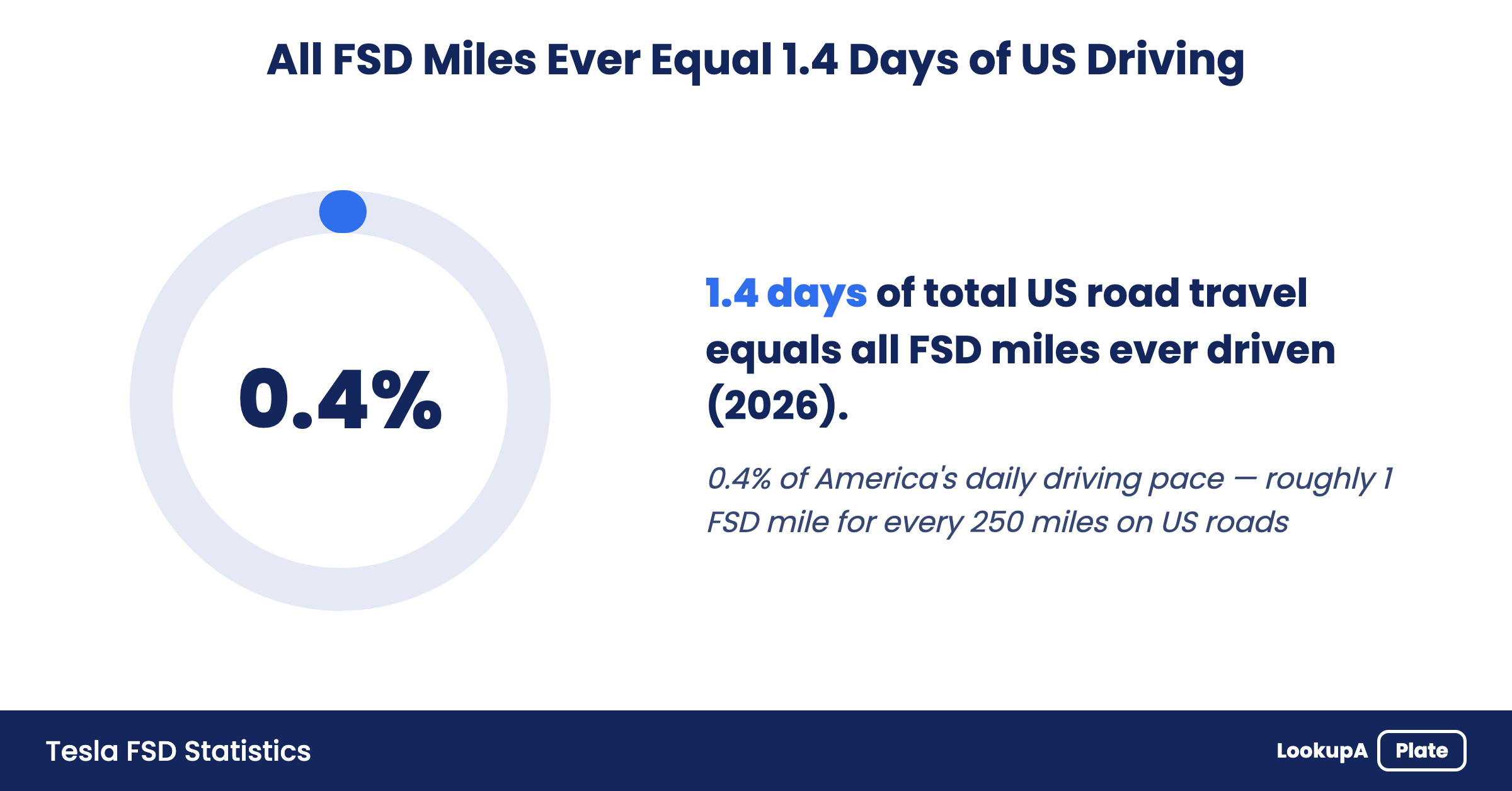
3. 1.4 days of total US road travel equals all FSD miles ever driven (2026)
0.4% of America’s daily driving equals what Tesla says FSD drives each day worldwide (2026). Roughly 1 FSD mile for every 250 miles driven on US roads.
The numerator comes from Tesla’s counter, an animation seeded July 18, 2026, that Tesla asserts tracks its fleet average and is not a measurement. Those FSD miles are global and the pace they run against is US (FHWA, CY2023), so this is a comparison, not a share.
How many people pay for FSD?
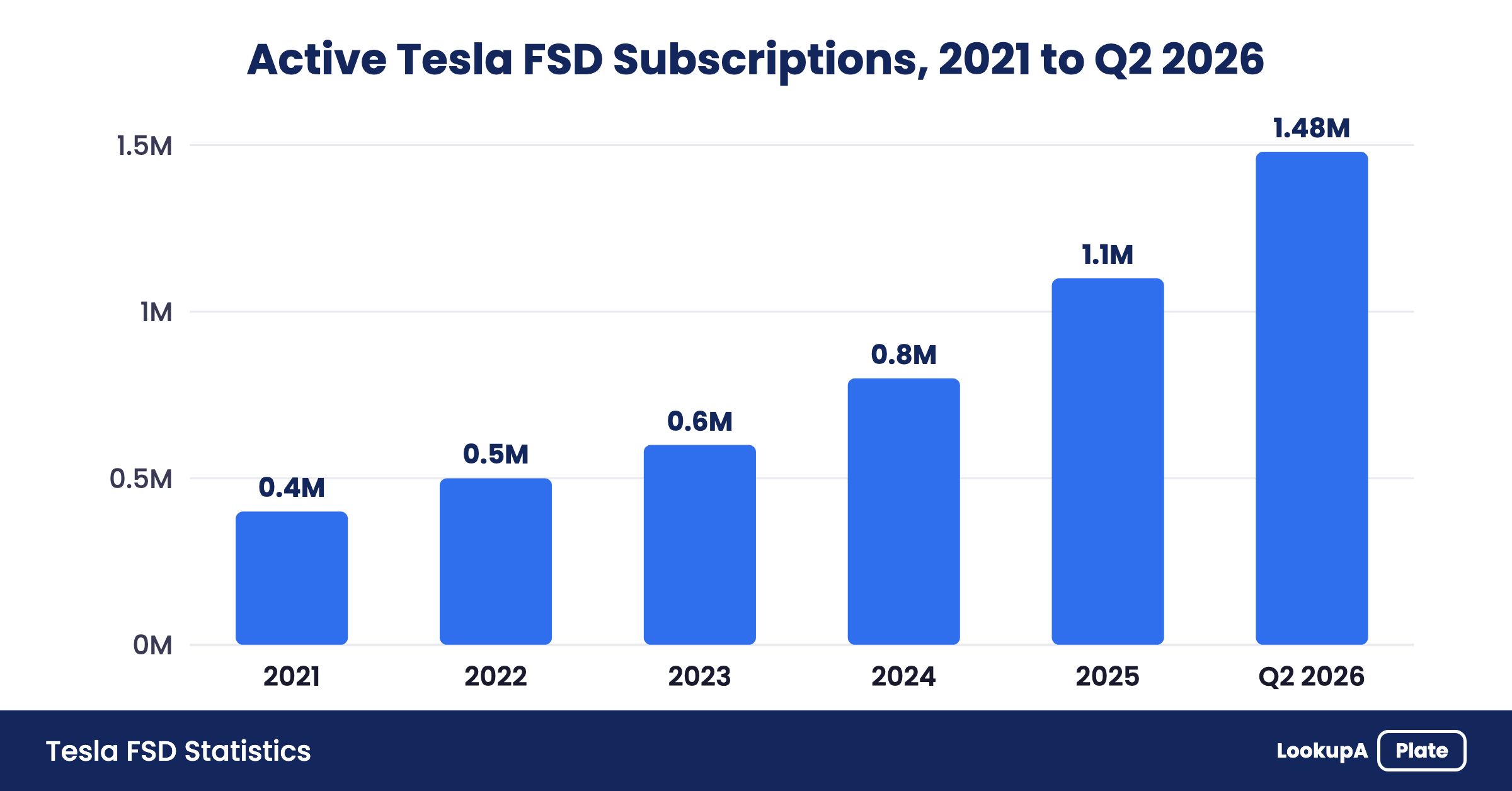
4. 1,480,000 FSD subscriptions were active in Q2 2026
That’s up 56% year over year, on a metric Tesla first disclosed on January 28, 2026. The series starts at 400,000 in 2021.
Tesla counts subscriptions rather than people, so a two-car household counts twice and a 2019 purchase still counts.
5. 25% of Tesla’s six-million-vehicle fleet paid for FSD by mid-2026
Roughly one car in four, a ratio Tesla has never printed. The denominator is Tesla’s own “over six million” marketing figure, so you are dividing by a number the company defines nowhere.
6. 55% of North American Q2 2026 Tesla deliveries included FSD
That’s an attach rate measured at delivery, not paid retention, and new cars arrive with a free trial running. About 2% of free-trial takers converted to paying in the v12.3-era trials, per a commercial YipitData panel of 3,500 owners in May 2024. Musk disputed the figure without offering another number, and two years and two funnel moments separate the figures.
What does FSD cost — and what does it earn Tesla?
7. $99 monthly became FSD’s only US price on February 14, 2026
Nothing else is on the US menu now. At $99, 81 months equal the $8,000 FSD purchase price Tesla discontinued in 2026, or about 6.7 years. Musk has said the $99 will rise, so the payback line you plan around is a ceiling.
8. ¥64,000 has been FSD’s unchanged China price since 2019
China is the only major market still selling FSD outright, and flagship features there are gated pending approval. It’s sold as “Tesla Assisted Driving,” on Tesla’s Chinese configurator, after three renamings stripped out every autonomy word. The “¥999 per month” price you will meet online is a fabricated conversion, with no monthly option on the configurator.
9. $4.05 billion of prepaid, undelivered features (including FSD) sat on Tesla’s books, June 2026
That bucket holds connectivity, FSD, free Supercharging, and over-the-air updates, and Tesla has never broken FSD out. Nobody can call this FSD’s deferred revenue, though it is the only audited number with FSD inside. New deferrals fell 19% in 2025 as buyers moved to subscriptions, which bypass the pool.
Where does FSD actually work?
10. 12 markets had Tesla FSD in place by August 2026, on Tesla’s own list
That count is the rollout list on Tesla’s safety page, and which page you read matters. Three Tesla pages gave 11, 12, and 13 on August 3, 2026, with China’s gated product as the swing. So the honest count is … whichever one you can name a page for.
11. More than 3,000 test hours preceded the Netherlands’ 2026 FSD approval
The Dutch regulator also ran 1,000-plus test runs and reviewed 1.8 million kilometres of European data, then moved Tesla’s reporting to monthly. About 40,000 Dutch Teslas drove roughly 24 million kilometers on FSD after April’s approval “without any relevant incidents,” in its words.
The approval is valid in the Netherlands only.
| Market | Status | Since | Price | Source (Aug 3) |
|---|---|---|---|---|
| United States | Subscription only, Feb 14, 2026 | Feb 14, 2026 (subscription-only, feature available years earlier) | $99/month | support page |
| Canada | Available | By Q1 2024 | n/a | subscriptions page |
| Mexico | Available | Date not published | n/a | same |
| Puerto Rico | US territory, listed separately by Tesla | Date not published | $99/month | same |
| Australia | Available | Date not published | A$149/month | same |
| New Zealand | Available | Date not published | n/a | same |
| South Korea | Since Q4 2025, missing from subscriptions list | Q4 2025 | n/a | Q4 2025 deck |
| Netherlands | Approved April 10, 2026, valid there only | Approved April 10, 2026 | n/a | RDW, June 2026 |
| Lithuania | Approved Q2 2026 | Q2 2026 | n/a | Q2 2026 deck |
| Estonia | Approved Q2 2026 | Q2 2026 | n/a | same |
| Denmark | Approved Q2 2026 | Q2 2026 | n/a | same |
| Belgium | Approved Q2 2026 | Q2 2026 | n/a | same |
| China | Sold, features gated pending approval | Sold since 2019, features still gated | ¥64,000 one-time | tesla.cn configurator |
| Great Britain | Not offered. Eight terms including “self-driving” restricted from Jan 7, 2027 (England, Wales, Scotland) | Not available | n/a | SI 2026/733 |
An approval or launch date is not a feature-parity date — China has sold the package since 2019 with its flagship features still switched off, and Europe’s approvals are national, not EU-wide.
Is Tesla FSD safe? Crash records and independent tests
Now the contested part.
12. 207 Tesla driver-assist crash reports were filed for May 2026
That’s the highest month on record, and January through June totals 826. Each count is a floor, with late reporting under open federal investigation. The series mixes fleet growth, a 2025 rule change, and adoption, which makes the month-to-month trend unreadable.
No mileage comes attached, so a count never becomes a rate. In 2025–26, 1,370 Tesla crash reports came via telematics, versus 113 from all other carmakers, an access gap NHTSA notes itself.
13. 59 Tesla crash reports through June 2026 alleged a fatality
That’s a count of reports, not of deaths.
The file has no fatality-count field and combines Autopilot with FSD, so 59 is a floor on the reports, not a verified death toll, and it will not tell you more. A closed NHTSA investigation tied at least 13 fatal crashes (14 deaths) to foreseeable Autopilot misuse through August 2023.
14. 4 federal investigations into Tesla driving automation were open in August 2026
The oldest opened in April 2024 and the newest in March 2026, all at NHTSA, and investigations are questions rather than findings. The last FSD recall was 2023’s 362,758-vehicle Beta recall (the larger 2,031,220-vehicle recall that year covered Autopilot), and there has been none since.
15. 3 independent test bodies rated Tesla poorly at keeping drivers attentive, 2020–2025
IIHS rated 11 of 14 systems Poor in March 2024, both Teslas among them, and Poor is the industry norm here. In 2025, Euro NCAP scored “Assistance Competence” 30 out of 100, unchanged in grade and core reason since 2020.
Consumer Reports scored “Keeping Driver Engaged” 3 out of 10 in October 2023, its most recent edition. The three agree on where Tesla is weak, not on the scores, so whichever grade you quote, quote its edition with it.
16. 1,983 miles per critical human takeover, per a 2026 owner-run FSD tracker (newest hardware only)
Miles to any takeover at all is 40, and both come from a self-selected owner panel, ad-supported by a vendor that also supplies data.
One 2026 FSD release came in at 60 miles per critical human takeover. Swings like that kill improvement claims either way. If you use it at all, use the long-run average as a trend line, never a level or a single version’s cell. Peer-reviewed 2024 work on 103 Tesla drivers found their takeovers reflected human judgment, not machine failure.
Tesla robotaxi statistics: fleets, miles, and the court record
Robotaxi is a different product.
17. 6 cities in 2 states hosted Tesla robotaxis by August 2026
They are Austin, Dallas, and Houston in Texas, plus Miami, Orlando, and Tampa in Florida. All are Model Y, on Tesla’s own robotaxi support page, and Tesla’s Q2 2026 deck lists Phoenix as “Preparations Underway.” In-car supervision came off in stages — not on a single date, and not everywhere at once.
Tesla’s Q2 2026 deck labels the Bay Area service “Safety Driver,” run by a human driver under a limousine-class permit.
18. 9 crashes per million paid robotaxi miles were reported through June 2026
That’s 22 federal crash reports against roughly 2.44 million paid miles from Tesla’s Q2 2026 deck chart. The 95% confidence interval runs 5.7 to 13.6.
The circulating “4× worse” figure counted any-contact federal reports against Tesla’s Delta-V-thresholded collision benchmark, two different event classes, over roughly half the then-current mileage. Paid miles are a floor on exposure, so the rate over all robotaxi driving is lower than this per-paid-mile figure. Recent report counts are still filling in.
19. 0 airbags deployed across 22 Tesla robotaxi crashes through June 2026
20 of the 22 were property-damage or no-injury events, and pre-crash speeds ran from 0 to 27 mph, in the federal driving-automation file. Crash-partner status is unknown in one of the reports, so that zero counts known deployments.
Twenty-two events over roughly 2.4 million miles describe the severity mix, and are too few to settle overall safety either way.
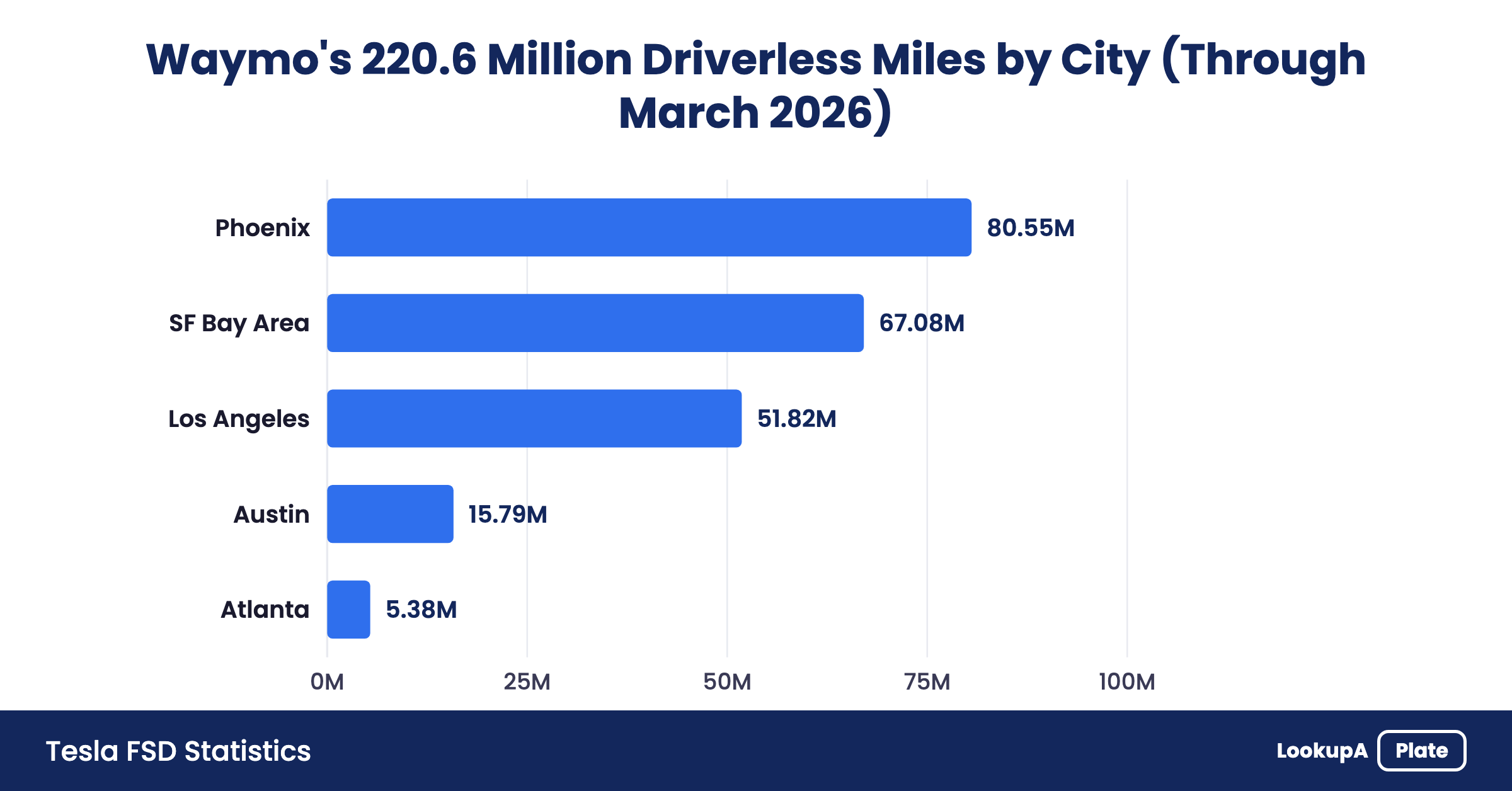
20. 220.6 million driverless miles were logged by Waymo through March 2026
Waymo’s safety hub lists them by city: Phoenix 80.55 million, the SF Bay Area 67.08 million, Los Angeles 51.82 million, Austin 15.79 million, and Atlanta 5.38 million.
Rider-only means no human in the Waymo driver’s seat. Tesla’s nearest disclosure is the chart above, and it counts paid miles.
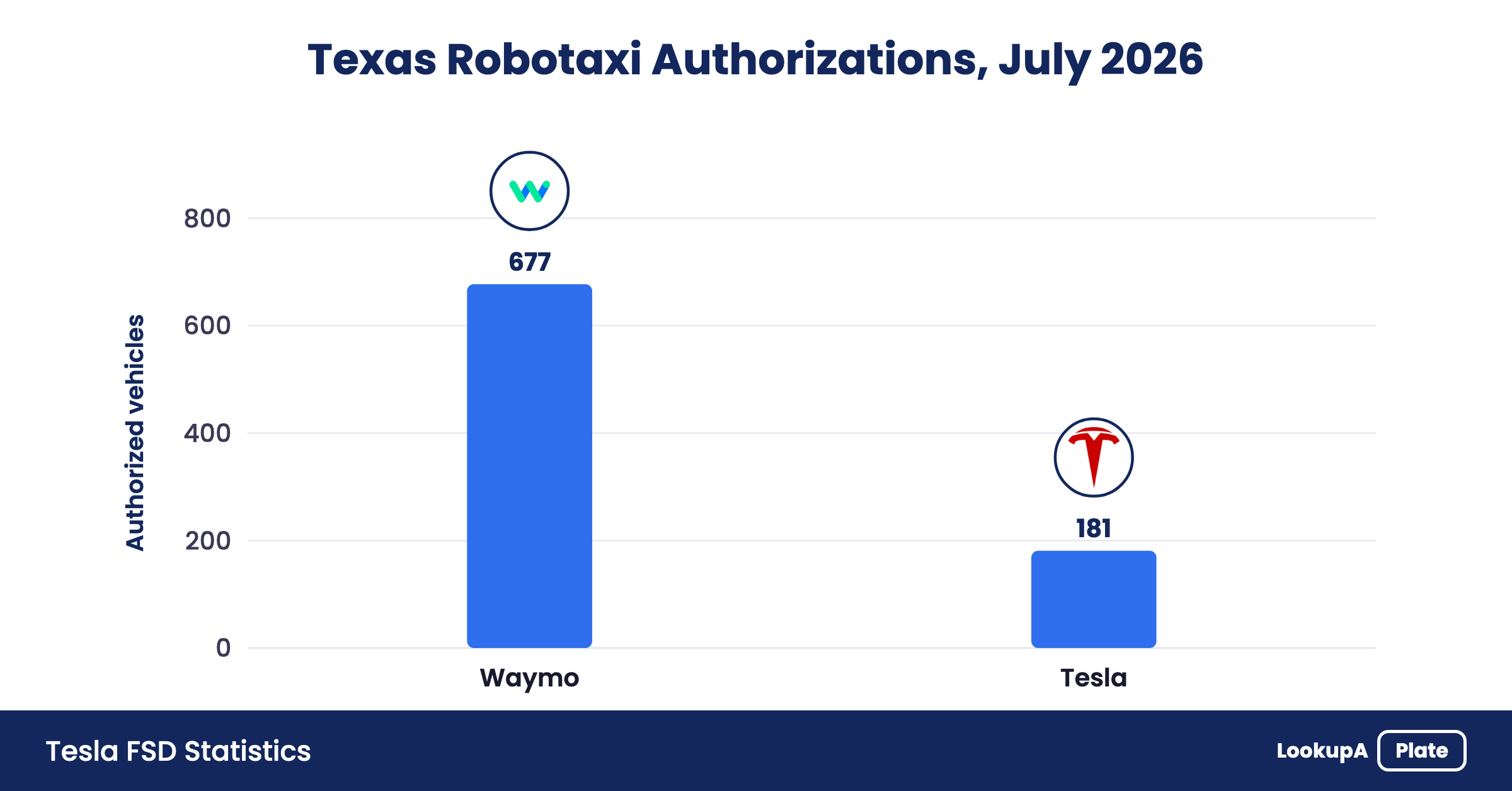
21. 181 Tesla robotaxis versus 677 Waymos held Texas authorizations, July 2026
The July counts come from a third-party mirror of Texas records. On the regime’s first day, May 28, Waymo held 577 authorizations to Tesla’s 42, per CNBC.
An authorization is not an operating vehicle, and we re-verify at publish. Tesla operates under Texas’s autonomous-vehicle authorization for technology it classifies as driver assistance in California.
22. 0 crash verdicts or settlements involve the FSD package through 2026
Every documented crash verdict or settlement against Tesla to date is an Autopilot or Enhanced Autopilot matter, per court opinions and a docket sweep. State cases can sit outside the federal docket archive, so the count is a floor.
$242,570,000 was awarded against Tesla in the 2025 Autopilot verdict, a case stayed on appeal. FSD’s court exposure to date is marketing-based rather than crash-based.
Why there’s no straight answer on FSD safety
One caution before you cite.
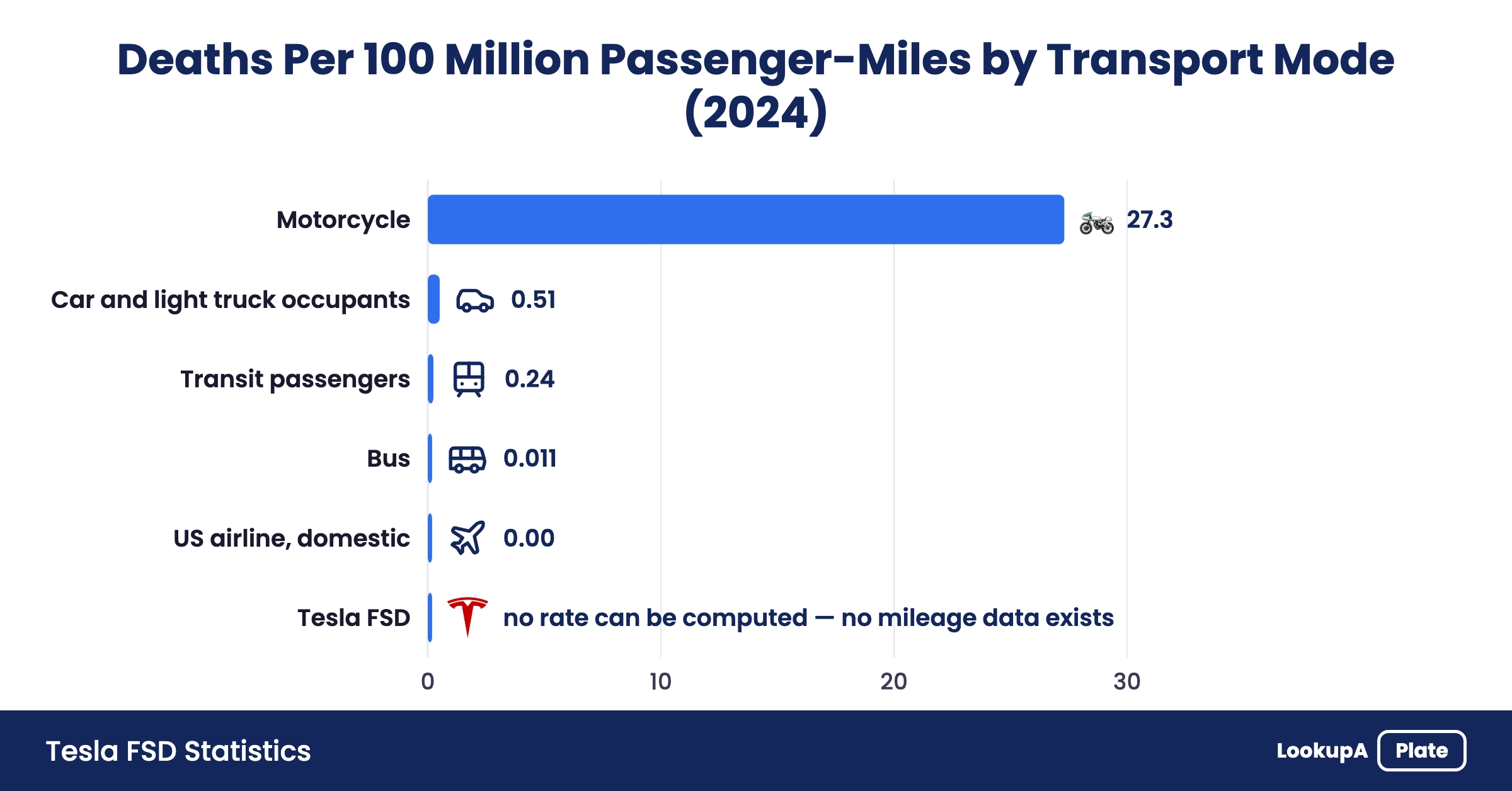
23. 5 transport modes have a 2024 fatality rate. Tesla FSD cannot be given one
| Mode | 2024 deaths | Deaths per 100M passenger-miles |
|---|---|---|
| Scheduled US airline, domestic | 0 | 0.00 |
| Bus | 40 | 0.011 |
| Transit passengers/occupants | 90 | 0.24 |
| Car and light truck occupants | 22,713 | 0.51 |
| Motorcycle | 6,228 | 27.3 |
| Tesla FSD | no count exists | no rate can be computed |
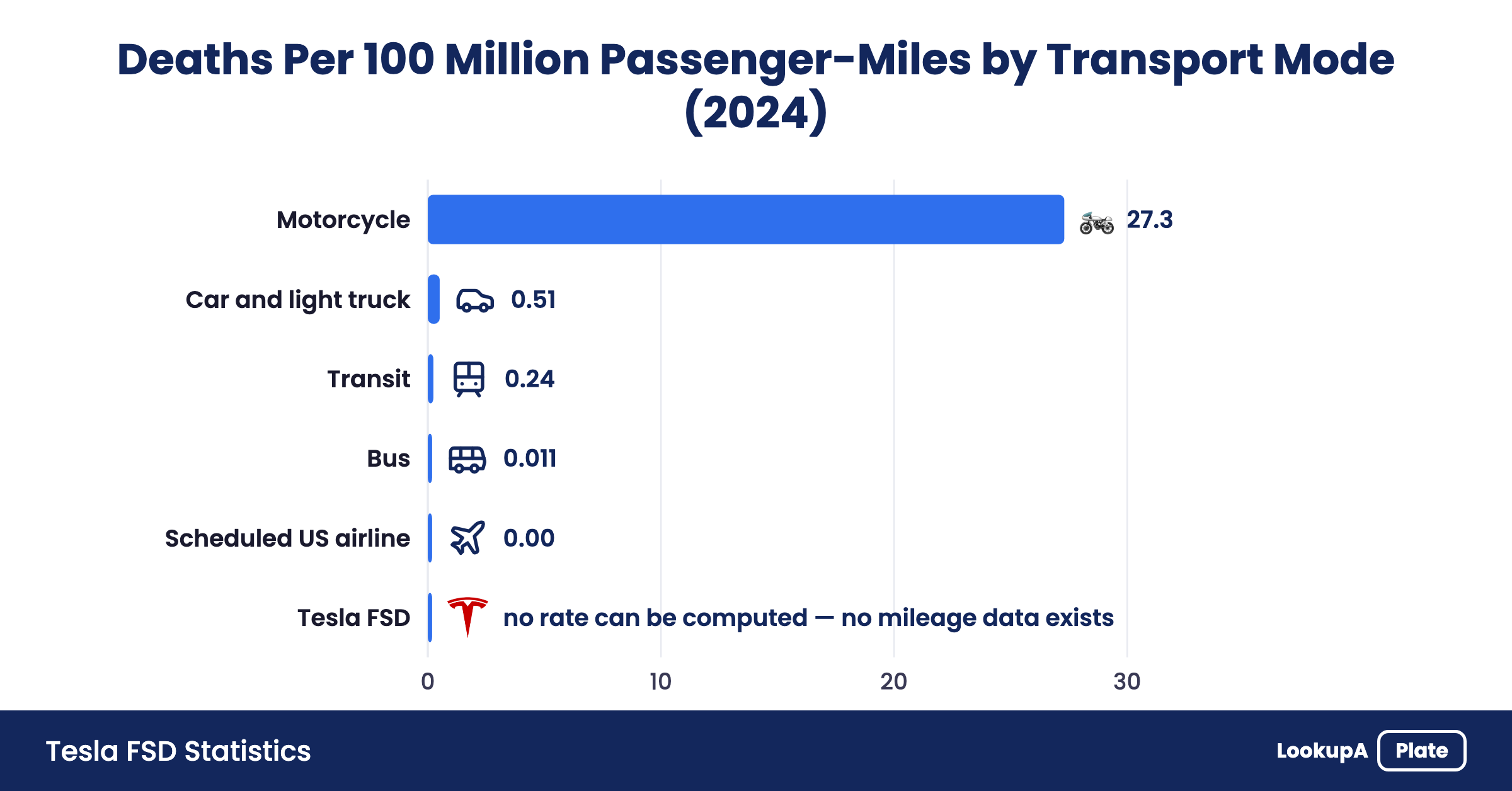
0 US airline fatalities in 2024, against 39,254 road deaths the same year. The road figure counts everyone killed on the road, so it runs well above the 22,713 car and light-truck occupants in the table.
Motorcycling is more than 50 times deadlier per mile than car travel, on 2024 federal data.
Every row is 2024, because BTS lists 2025 as unavailable. The airline row divides all 14 CFR 121 deaths by domestic passenger-miles, which is harmless only while the numerator is zero.
The highway passenger-miles are modelled from vehicle-miles times survey occupancy, which makes that row the weakest denominator here. BTS’s own note reads, “Caution must be exercised in comparing passenger miles across modes because significantly different definitions are used.”
0 agencies collect the mileage needed to calculate an FSD safety rate (2026). Tesla’s own mileage is self-asserted vehicle-miles rather than passenger-miles, so even that number cannot fill the row.
That is a fact about what the public data holds, not a claim that FSD is safe or unsafe.
24. 100% of Tesla’s 2025–26 federal crash reports redact the software-version field
NHTSA’s file holds 3,763 unique Tesla Level 2 crash reports through June 2026, and not one current-era report names the software version. The redaction is lawful: NHTSA is legally prohibited from disclosing what Tesla marks as confidential business information, so no public dataset can separate an FSD crash from an Autopilot crash.
0 mileage or fleet-size data accompanies federal driver-assist crash reports (2026), so nobody outside Tesla can compute a true FSD crash rate.
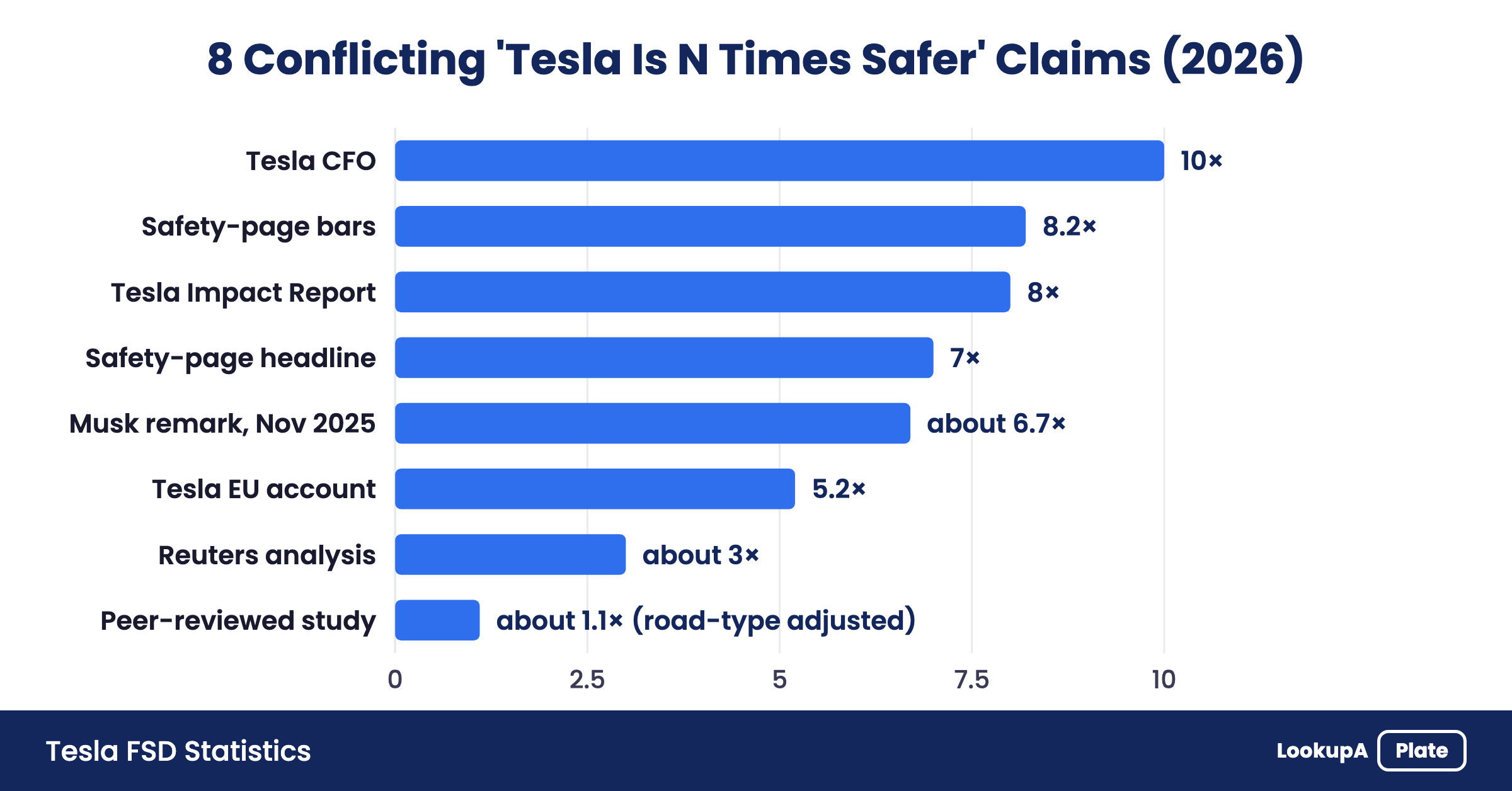
25. 8 different “Tesla is N times safer” claims circulated in 2026, spanning 1.1 to 10
The right question for each is the same: compared with whom, over what window? Tesla’s safety page carries two at once, a 7× headline and 8.2× implied by its own bars, which are rolling 12-month numbers refreshed quarterly.
Whatever figure you take from that page needs the date you read it, because no single multiple is publishable as fact.
26. 30 reports per 100 million miles is the FSD division that fails three ways (2026)
Divide NHTSA’s 3,763 Tesla crash reports by the 12.45 billion FSD miles on Tesla’s counter: 30 reports per 100 million miles. The division fails three ways.
The reports span two products, Autopilot and FSD. The miles count only FSD. The reports are a US-only undercount, the miles a global Tesla-claimed figure. And the reports match no benchmark’s event class.
US police-reported crashes run about 189 per 100 million miles, one per 530,000, on a different instrument. No third-party data verifies either side.
The 30-to-189 gap measures mismatched inputs, not safety.
27. 59% more crashes followed Autosteer installation in the 2019 reanalysis of NHTSA’s own data
This one kills a number that flattered Tesla. NHTSA’s famous “40% crash reduction” for Autosteer is retracted in substance, and the only cohort with complete mileage, 5,714 of 43,781 vehicles, shows airbag-deployment crashes rising from 0.76 to 1.21 per million miles. NHTSA itself conceded in 2018 that it “did not assess” the technology’s effectiveness, and the reanalysis came from QCS Corp., which reports no financial interest.
| Multiple | Source | Comparison group | Window |
|---|---|---|---|
| 7× | Tesla safety page | US average driver | read Aug 3, 2026 |
| 8.2× | Same page’s bars | 5.7M vs 699K miles per collision | rolling 12 months |
| 8× | Tesla Impact Report | Tesla-defined | annual |
| 10× | Tesla CFO | not stated | undated |
| About 6.7× | Musk, public remark | not stated. “85% less crashes,” converted 100 ÷ 15, company-asserted | November 2025 |
| 5.2× | Tesla’s EU account | European fleet | 4-month window |
| About 3× | Reuters-commissioned analysis | airbag against tow-away | 2026 |
| About 1.1× | Goodall, peer-reviewed | road type controlled | 2018 to 2021 |
| 1.6× | Tesla’s 2019 California filing | its own active-safety cars | the reconciler, not one of the 8 |
| 39,254 US road deaths in 2024, 1 police-reported crash per an estimated 530,000 miles | NHTSA | all US traffic | context only, not Tesla’s airbag metric |
| “32,000 lives saved” | Tesla footnote | assumes every US vehicle runs FSD | 0 peer-reviewed estimates exist |
What these statistics mean for you
What you do with all of this depends on why you came.
1. For car shoppers
It’s easy to assume the subscription is the cheap way in. So how long do you plan to keep the car? At $99 a month the subscription passes the old $8,000 price at 81 months, cheaper over five years and dearer over ten.
Tesla’s robotaxi terms cap contractual liability at the fare or $100, whichever is greater. A contract term is not a limit on what a court can award you. One Texas owner won $10,672.88 in small claims over undelivered FSD, a single case documented by Electrek, not a class outcome.
2. For journalists
Date everything you quote, because a counter read and a safety multiple both spoil. Before you republish a rate, ask what its denominator is and which class of crash it counts. It’s worth checking filings rather than announcements.
9 announced FSD launch dates for Europe and China slipped between 2024 and 2026. On the two occasions when a regulator commented publicly on a slipped date, the regulator contradicted Tesla. Tesla’s total reported California autonomous driving, 2015 to 2020, was 562 miles (an absence that is lawful under its driver-assistance classification there).
3. For fleet and insurance professionals
The market has barely priced this. As of mid-2026, 0 mainstream US insurers besides Tesla’s own and Lemonade priced FSD, and the rate-filing database that would settle it was not searchable here.
Lemonade discounts FSD miles by 50%, justified on its own page by Tesla’s safety data rather than Lemonade’s loss experience. Tesla’s insurers paid $1.004 in claims per premium dollar in 2025.
That is roughly 40 points worse than the industry, per S&P Global Market Intelligence via the trade press. If you underwrite these cars, repair cost rather than crash frequency plausibly drives it.
Frequently asked questions about Tesla FSD
What percentage of Tesla has FSD?
25% of Tesla’s six-million-vehicle fleet paid for FSD by mid-2026. Source: Tesla’s fleet figure against its Q2 2026 subscriptions.
How many miles of self-driving does Tesla have?
12,445,140,996 FSD miles stood on Tesla’s counter July 18, 2026, all of it supervised driving with a human responsible at the wheel. Source: tesla.com/fsd, read on July 18, 2026.
How many Tesla FSD accidents?
There is no FSD-only count. 100% of Tesla’s 2025–26 federal crash reports redact the software-version field, and 0 mileage or fleet-size data accompanies federal driver-assist crash reports (2026). Source: NHTSA’s standing general order data, June 2026.
Is FSD worth $8000?
$99 monthly became FSD’s only US price on February 14, 2026. At $99, 81 months equal the $8,000 FSD purchase price Tesla discontinued in 2026. Source: Tesla’s US support pages, read August 3, 2026.
Is Tesla FSD improving over time?
1,983 miles per critical human takeover, per a 2026 owner-run FSD tracker (newest hardware only). Single-release readings on the same tracker ran from 60 to 6,286 miles, too noisy to read as improvement in either direction. Source: that owner-run tracker, read August 3, 2026.
Is Tesla autopilot actually safe?
8 different “Tesla is N times safer” claims circulated in 2026, spanning 1.1 to 10. And 3 independent test bodies rated Tesla poorly at keeping drivers attentive, 2020–2025. Source: Tesla’s safety page, IIHS, Euro NCAP, and Consumer Reports.
How many Tesla drivers use FSD?
Tesla publishes no driver count. The closest figure is 1,480,000 active FSD subscriptions in Q2 2026, and a two-car household counts twice. Source: Tesla’s Q2 2026 deck, as filed with the SEC.